

I’m going to level with you. When I started writing, I had this wild fantasy that somehow, I could condense everything about staking on Cardano and that it would be the “Go to idiots guide” for information.
Again, I said this was a fantasy, which quickly started to unravel when I learned about all the math and staking protocols and cool acronyms like SPO, ISPO and this calculator that uses letters to represent numbers. This is the part where I go out looking for a chainsaw wielding whack job to just come do me in and the story ends.
Instead of covering all aspects of staking, I am going to take it slow, like the lady that I am, and we can start off simple.

If you face planted onto Cardano like I did, the information readily available, has been written, (in my opinion) for a demographic of users whose native language is not simple, but mathematical and computer coder stuff. I am neither.
To understand Cardano Stake Pools, it is worth a quick recap of what Cardano is and why stake pools and staking is important.
Cardano is a PoS, Proof of Stake Blockchain. Each new block of the blockchain needs to be added to a node. Nodes comprise of groups of people who have come together or in this case, pooled together in a stake pool.
Staking your ADA, also known as Delegating, is an uncomplicated way to increase returns. Staking/Delegating your ADA helps validate transactions on the blockchain, while adding security and contributing to Cardano’s decentralization through a non-consensus mechanism.
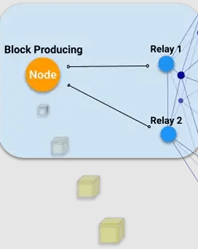
This is an example of the Cardano blockchain node, I literally googled “What is a Cardano Node” and image searched.

When I look at the image above my brain instantly tries to transform that into something I could understand and relate to in the real world.
(Please don’t try to psychoanalyze me, I’ve accepted and embraced the reality that I’m weird).
This is how I see the Cardano Network

Those little notches on the geometric dome are the nodes.
And all those kids are like information that travels across the network. They can also come together to create a stake pool, which again my brain takes from this:

And in my head, it looks like a pool Conga Line.

When people come together, they strengthen and secure Cardano’s decentralization!
Do you see what is happening here? The Benefits of staking on Cardano is that you are helping to secure the network. Pretty cool.
If I were a mind reader, I’d guess the next question would be “Why would I stake/delegate and how do I do it?”
The Benefits of staking/delegating on Cardano is that Cardano has no lockup periods. You hold full custody of your ADA; therefore, it is non-custodial staking meaning your ADA staked on Cardano is liquid. When you delegate your ADA to a stake pool through a Cardano native wallet like Eternl, you can withdraw your stake at any time. You can also move it to another stake pool at any time.
If you are already holding ADA and NFT’S in your wallet, then staking is a no brainer. Remember, NFT’s are illiquid, which means you cannot swap them out instantly for cash. ADA, and other Native tokens like $NFTC are liquid assets that can be exchanged for cash.
By delegating/staking your wallet you earn rewards like interest in a bank savings account and sometimes more or less depending on the pool. Delegating also allows you to take advantage of native tokens such as $NFTC through Drip Dropz. Other token drip systems include Taptools and Tosi. To collect your tokens every epoch, you must delegate/stake to a stake pool.

Cardano has native liquid staking, which means you can receive rewards for staking and simultaneously receive rewards for providing liquidity to a liquidity pool. $NFTC Liquidity Pool
Moving on, let’s look at time, cost, math (eww).
To participate in a stake pool, select which pool you would like to delegate to, DYOR when considering the value and the returns offered, and if the pool is saturated.
For the sake of keeping things simple, for now let’s assume you have decided to stake to NFTC stake pool.
Time
- The first time you delegate your wallet to a stake pool You choose a stake pool which you will delegate your stake to
- After an initial set-up period of 15-20 days, you will receive rewards every epoch (5 days)
Cost
There is no minimum defined coins required to participate in staking, but from personal experience, and more from user error (I never claimed to be smart) I have seen minimums of at least 5 ADA.
Math
Cardano has these biz whiz people that write and create lots of cool things like a calculator that you can use to determine how much you can earn from staking ADA. Click here to try it.

Unstaking
If you think Cardano is destined to increase in value, like myself, then staking ADA is a fantastic way of generating passive income.
Everything shared here is intentionally written as a user-friendly introduction into what staking, delegating and stake pools are on Cardano.
For a more in-depth look that is rich with formulas, big words, and charts, use the internet browser to find content that speaks to your interests and intellect.

 HUMPDAY SPACE